Basics


Info Download

Advanced

v/v
V
V

Plot Download

She released the clamps, slid the profile to the next stop, and reclamped. She selected the tool, manually rotated the turret head until it clicked into place, and then slowly, carefully, cranked the X-axis hand wheel to the mark. She checked the Y-axis dial indicator. Perfect. She pulled the feed lever.

The drill plunged. Aluminum chips spiraled away like tiny curled ribbons. The motor pitch deepened, then lifted. She retracted the drill. Clean. Perfect. No chatter marks.

She smiled. She wasn’t just an apprentice anymore. She was an operator. And the SBZ 130 had made her one.

“People think automatic is better,” he said. “But automatic makes you lazy. This machine—the Elumatec SBZ 130 Manual—she teaches you something a robot never can. She teaches you to think before you move. To measure twice. To feel the metal. To own your work.”

She looked. Her face went red. The drill would have hit the edge of a reinforcement web, snapped the bit, and ruined the profile. “I’m sorry,” she whispered.

Lena’s heart hammered. Her task was to drill a series of drainage holes and pilot holes for a locking mechanism—sixteen precise operations per profile. She consulted the setup sheet: SBZ 130, manual mode. Tool position: Drill chuck #3. Diameter 5mm. Depth 8mm. Coordinates: X=120mm, Y=22mm from top edge.
Disclaimer: This tool is provided for educational and illustrative purposes only. No guarantee is made regarding accuracy, suitability, or performance. Use at your own risk. - Copyright: ufelectronics.eu / Andreas Dyhrberg

×
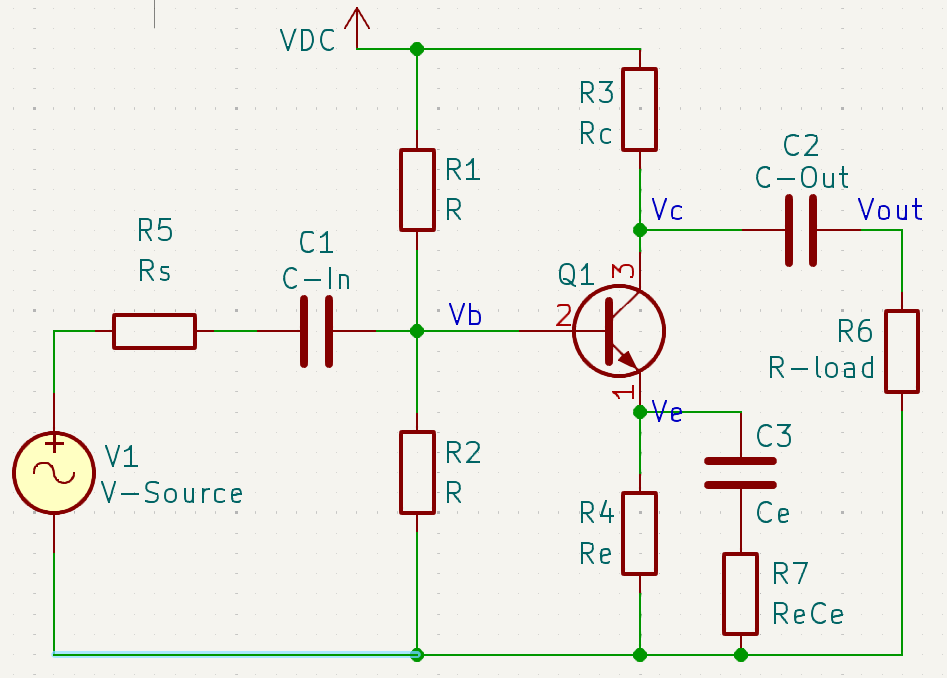
Amplifier Schematic
×

There are different ways to calculate an amplifier, depending on what you want to achieve.

Maybe you want to achieve a certain gain, as far as possible (classic mode). Or you have a low Vcc to respect (modern mode). Or you work with analog audio amps (symmetry mode).

Depending on what you want to achieve and the way of calculating it. Some fields might become dependent on others, or the other way around.

Your above choise makes some input fields available for manipulation, while hiding others.


🎯 1. Target Gain (Av) — "Classic mode" Elumatec Sbz 130 Manual

You care about how much your amplifier multiplies the input signal.

Set desired voltage gain and Rc voltage drop. Best for learning and simple amplifiers.

You say: “I want a gain of 10.”
The app adjusts resistors to try and match that.
You must give Av and Vrc (the voltage dropped across Rc).

Best for common emitter amplifiers.

✅ Default choice for most beginners and educational use. She released the clamps, slid the profile to


⚡ 2. Target Emitter Voltage (Ve) — "Modern mode"

You care about setting a healthy DC bias point.

Prioritize stable biasing via Ve. Useful for low-voltage circuits or precision designs.

You say: “I want Ve = 0.5 V, to keep the transistor out of trouble.”
This makes sure your transistor stays in active mode.
Gain becomes whatever it turns out to be.

Ideal for common emitter amplifiers when the goal is to ensure proper biasing for low-voltage or precision circuits, and it’s also used in class AB amplifiers to prevent distortion Perfect

✅ Useful in low-voltage designs (e.g., 3.3V systems).


🧭 3. Target Collector Voltage (Vc) — "Symmetry mode"

You want to place the collector in the middle of the power rail.

Target Vc = Vcc/2 for maximum signal swing. Great for audio and analog signals.

You say: “Make Vc = Vcc/2” for maximum swing.
Useful for analog audio amps or symmetrical headroom.
Gain and Ve are outcomes.

Best for common collector amplifiers and class AB amplifiers.

✅ Best for signal integrity.

Elumatec Sbz 130 Manual (2024-2026)

She released the clamps, slid the profile to the next stop, and reclamped. She selected the tool, manually rotated the turret head until it clicked into place, and then slowly, carefully, cranked the X-axis hand wheel to the mark. She checked the Y-axis dial indicator. Perfect. She pulled the feed lever.

The drill plunged. Aluminum chips spiraled away like tiny curled ribbons. The motor pitch deepened, then lifted. She retracted the drill. Clean. Perfect. No chatter marks.

She smiled. She wasn’t just an apprentice anymore. She was an operator. And the SBZ 130 had made her one.

“People think automatic is better,” he said. “But automatic makes you lazy. This machine—the Elumatec SBZ 130 Manual—she teaches you something a robot never can. She teaches you to think before you move. To measure twice. To feel the metal. To own your work.”

She looked. Her face went red. The drill would have hit the edge of a reinforcement web, snapped the bit, and ruined the profile. “I’m sorry,” she whispered.

Lena’s heart hammered. Her task was to drill a series of drainage holes and pilot holes for a locking mechanism—sixteen precise operations per profile. She consulted the setup sheet: SBZ 130, manual mode. Tool position: Drill chuck #3. Diameter 5mm. Depth 8mm. Coordinates: X=120mm, Y=22mm from top edge.