Attribution Creative Commons Noncommercial No Derivatives Share Alike Zero

Rumble Roses Face Heel Characters -mod- -norm... -

But the mod wasn’t stable. Reiko’s vision glitched: one moment she saw the ring ropes as prison bars; the next, as rainbow bridges. The game’s “Normal Mode” code—the balance of face and heel—was bleeding into reality. Every punch she threw healed her opponent’s fatigue bar. Every taunt she made triggered her own damage over time.

The mod had done something. Not just to her moves. To her logic . Backstage, Anesthesia (the resident sadist) watched from the shadows. Her mask hid a smile. “Finally,” she whispered. “The queen of hope becomes the queen of hurt.”

And for the first time, the crowd didn’t cheer or boo.

On the screen of her phone, a modding forum scrolled past. “Rumble Roses: Face/Heel Swap – Total Personality Inversion Mod – Normal Mode Corrupted?” Rumble Roses Face Heel Characters -Mod- -Norm...

She shouldn’t have clicked it. But curiosity was a heel’s game.

The screen went black.

Then, in tiny green text: “Face and Heel are costumes. You are the player. Choose wisely next time.” But the mod wasn’t stable

When Reiko woke up in the locker room, her pink costume was gone. She wore gray sweats. No logo. No side.

She was a paradox. A Face who hurt to save. A Heel who saved by hurting. The final boss of the mod wasn’t a wrestler. It was a line of code: if (character.morality == “pure”) then (reality.crack()) . Reiko realized the modder hadn’t wanted a swap. They’d wanted to see if the game itself could break its own heart.

The download took three seconds. The installer didn’t ask for permission. It just whispered: “Balance requires shadow.” First match: against Noble Rose, her own tag partner. Reiko stepped into the ring, raised a hand for the crowd’s familiar cheer—but her fingers curled into a claw. The audience gasped. She kicked Noble in the gut. Not a wrestling kick. A street kick. Then she laughed. A low, gravelly sound that didn’t belong to her face. Every punch she threw healed her opponent’s fatigue bar

In the center of the ring, facing a mirror image of herself—a “Normal Reiko” who had never touched the mod—she made a choice. She didn’t strike. She didn’t submit. She simply unplugged her controller.

Here’s a short, interesting story-style piece based on your prompt: “Rumble Roses: Face / Heel Characters – Mod – Normal…” The locker room lights flickered—buzzing like a trapped insect. Reiko Hinomoto, the eternal Face of the women’s wrestling circuit, sat on a wooden bench, staring at her reflection. Her white and pink costume seemed almost too bright tonight.
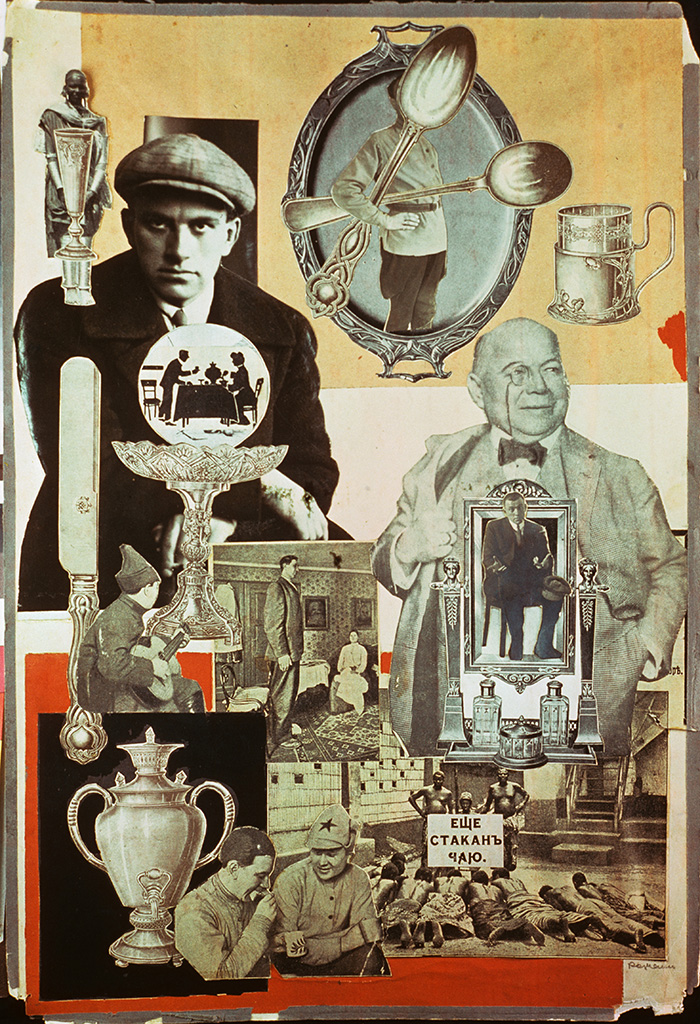
Fig. 1. — Brigade KGK (Viktor Koretsky [1909–98], Vera Gitsevich [1897–1976], and Boris Knoblok [1903–84]). “We had to overcome among the people in charge of trade the unhealthy habit of distributing goods mechanically; we had to put a stop to their indifference to the demand for a greater range of goods and to the requirements of the consumers.” From the 16th to the 17th Congress of the All-Union Communist Party (Bolsheviks), 1934, no. 57, gelatin silver print, 22.7 × 17 cm. Los Angeles, Getty Research Institute, 2014.R.25.
Fig. 2. — Brigade KGK (Viktor Koretsky [1909–98], Vera Gitsevich [1897–1976], and Boris Knoblok [1903–84]). “There is still among a section of Communists a supercilious, disdainful attitude toward trade in general, and toward Soviet trade in particular. These Communists, so-called, look upon Soviet trade as a matter of secondary importance, not worth bothering about.” From the 16th to the 17th Congress of the All-Union Communist Party (Bolsheviks), 1934, no. 56, gelatin silver print, 22.7 × 17 cm. Los Angeles, Getty Research Institute, 2014.R.25.
Collage of photographs showing Vladimir Mayakovsky surrounded by a silver samovar, cutlery, and trays; two soldiers enjoying tea; a giant man in a bourgeois parlor; and nine African men lying prostrate before three others who hold a sign that reads, in Cyrillic letters, “Another cup of tea.”
Fig. 3. — Aleksandr Rodchenko (Russian, 1890–1956). Draft illustration for Vladimir Mayakovsky’s poem “Pro eto,” accompanied by the lines “And the century stands / Unwhipped / the mare of byt won’t budge,” 1923, cut-and-pasted printed papers and gelatin silver photographs, 42.5 × 32.5 cm. Moscow, State Mayakovsky Museum. Art © 2024 Estate of Alexander Rodchenko / UPRAVIS, Moscow / ARS, NY. Photo: Art Resource.
Fig. 4. — Boris Klinch (Russian, 1892–1946). “Krovovaia sobaka,” Noske (“The bloody dog,” Noske), photomontage, 1932. From Proletarskoe foto, no. 11 (1932): 29. Los Angeles, Getty Research Institute, 85-S956.
Fig. 5. — Brigade KGK (Viktor Koretsky [1909–98], Vera Gitsevich [1897–1976], and Boris Knoblok [1903–84]). “We have smashed the enemies of the Party, the opportunists of all shades, the nationalist deviators of all kinds. But remnants of their ideology still live in the minds of individual members of the Party, and not infrequently they find expression.” From the 16th to the 17th Congress of the All-Union Communist Party (Bolsheviks), 1934, no. 62, gelatin silver print, 22.7 × 17 cm. Los Angeles, Getty Research Institute, 2014.R.25.
Fig. 6. — Brigade KGK (Viktor Koretsky [1909–98], Vera Gitsevich [1897–1976], and Boris Knoblok [1903–84]). “There are two other types of executive who retard our work, hinder our work, and hold up our advance. . . . People who have become bigwigs, who consider that Party decisions and Soviet laws are not written for them, but for fools. . . . And . . . honest windbags (laughter), people who are honest and loyal to Soviet power, but who are incapable of leadership, incapable of organizing anything.” From the 16th to the 17th Congress of the All-Union Communist Party (Bolsheviks), 1934, no. 70, gelatin silver print, 22.7 × 17 cm. Los Angeles, Getty Research Institute, 2014.R.25.
Fig. 7. — Artist unknown. “The Social Democrat Grzesinski,” from Proletarskoe foto, no. 3 (1932): 7. Los Angeles, Getty Research Institute, 85-S956.
Fig. 8A. — Pavel Petrov-Bytov (Russian, 1895–1960), director. Screen capture from the film Cain and Artem, 1929. Image courtesy University of California, Berkeley, Berkeley Art Museum and Pacific Film Archive Library.
Fig. 8B. — Pavel Petrov-Bytov (Russian, 1895–1960), director. Screen capture from the film Cain and Artem, 1929. Image courtesy University of California, Berkeley, Berkeley Art Museum and Pacific Film Archive Library.
Fig. 8C. — Pavel Petrov-Bytov (Russian, 1895–1960), director. Screen capture from the film Cain and Artem, 1929. Image courtesy University of California, Berkeley, Berkeley Art Museum and Pacific Film Archive Library.
Fig. 9. — Herbert George Ponting (English, 1870–1935). Camera Caricature, ca. 1927, gelatin silver prints mounted on card, 49.5 × 35.6 cm (grid). London, Victoria and Albert Museum, RPS.3336–2018. Image © Royal Photographic Society Collection / Victoria and Albert Museum, London.
Fig. 10. — Aleksandr Zhitomirsky (Russian, 1907–93). “There are lucky devils and unlucky ones,” cover of Front-Illustrierte, no. 10, April 1943. Prague, Ne Boltai! Collection. Art © Vladimir Zhitomirsky.
of