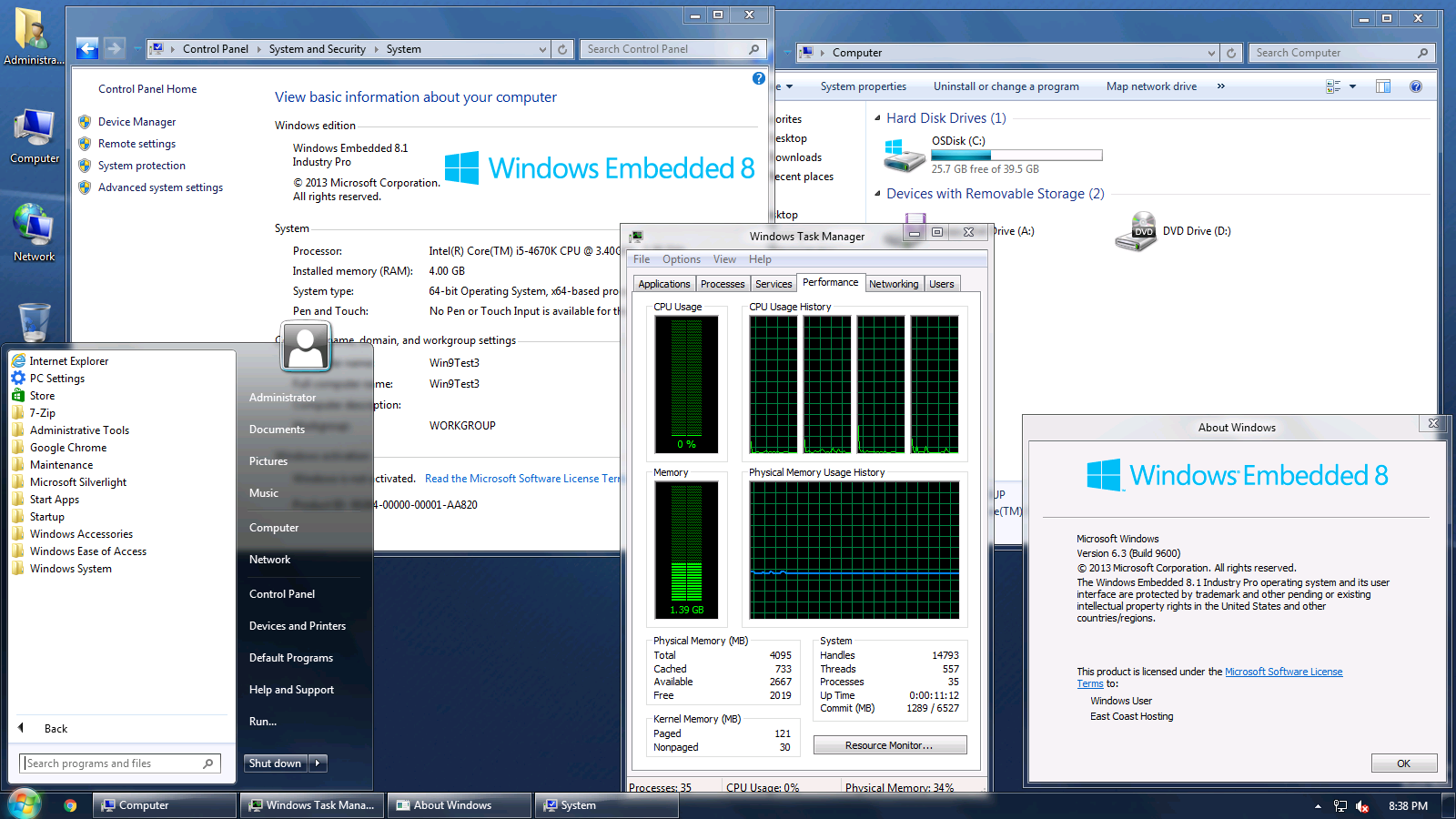
This is a modified version of Windows 8.1 Embedded Industry Pro. I call it "Windows 9"
It was designed to bring back the UI from Windows 7, while keeping the kernel improvements from 8.1
You need a license key to activate this operating system.
If you are in college, check if you have a Microsoft Imagine subscription. You can usually get an 8.1 Embedded Industry Pro license key from Microsoft Imagine for free.
Windows 9 is x64 only - this will not work on 32 bit systems.
If affected by a black screen issue after windows update, please visit this page for instructions on how to repair.
Screenshot of the system:
Conversely, defenders argue that the film uses Boyle’s outsider energy to break the conventions of both Bollywood (which often sanitizes poverty) and Western arthouse (which often treats poverty as static misery). The film’s energy—the relentless forward momentum—refuses to let the audience wallow. It is a film about flight, not imprisonment. Latika is the film’s most problematic element. She is the narrative engine—Jamal does everything “for her”—but she has almost no interiority. She is a classic “Manic Pixie Dream Girl” crossed with a damsel in distress. Her primary actions are: being taken, waiting, and looking beautiful. Even her name (“latika” meaning “a small, creeping vine”) suggests dependence.
Critics (notably from the Subcontinent) argue that Slumdog performs a form of “poverty porn”—a Western gaze that aestheticizes suffering for a global audience’s uplift. The opening chase through the Dharavi slums is breathtaking cinema: the kinetic camera, the plunging crane shots, the vibrant color palette against corrugated tin. But this aestheticization risks turning real human misery into exotic spectacle. The audience is invited to feel triumphant when Jamal escapes, but rarely asked to sit with the structural conditions that produce such escapes as necessary. slumdog millionaire film analysis
The film’s romantic logic is deeply conservative. Jamal wins Latika not by her agency, but by his persistence. The climactic reunion at Victoria Terminus (a colonial monument) frames her as a reward—the final prize after the 20 million rupees. The script attempts a feminist fig leaf when Latika asks, “What can we live on?” and Jamal answers, “Love.” But the film has not dramatized her love; it has dramatized his obsession. This gap between symbolic function and character depth is the film’s central flaw, revealing the limits of its fairy-tale structure. The final scene—the choreographed dance to “Jai Ho” at the train station—is often dismissed as a tacked-on concession to Indian audiences. In fact, it is a formal and ideological masterstroke. For two hours, the film has operated under the rules of gritty, neorealist drama: violence is sudden, authorities are corrupt, and poverty maims. The dance sequence breaks diegetic reality. It announces: This is not real. This is a fantasy. Conversely, defenders argue that the film uses Boyle’s
Slumdog Millionaire is a cinematic paradox: a feel-good film built on a foundation of profound suffering; a Bollywood-inflected fairy tale shot through with the gritty, handheld realism of a social exposé; a love story where the protagonists spend most of the runtime separated. Upon its release, it became a global phenomenon, winning eight Academy Awards, but it also ignited fierce debates about poverty voyeurism and the authenticity of its depiction of India. To analyze the film is to navigate these contradictions, focusing on its central thesis: that destiny is not a gentle guiding hand but a brutal, shaping force, and that Jamal Malik’s triumph is not a matter of luck, but of traumatic experience converted into capital. 1. Narrative Structure: The Inversion of the Bildungsroman The film’s most celebrated innovation is its formal structure. It inverts the classic Bildungsroman (coming-of-age story) by rejecting linear progression. Instead, it operates through a concentric spiral: every question on Who Wants to Be a Millionaire? acts as a Proustian madeleine, triggering a flashback that explains how Jamal knows the answer. Latika is the film’s most problematic element
The film’s legacy remains contested. For some, it is a triumphant humanist fable. For others, it is a digital postcard from hell, stamped with a Hollywood smile. Ultimately, Slumdog Millionaire succeeds as a high-wire act of tone: it is the rare film that can show a child blinded for a song and then, fifteen minutes later, have you cheering at a dance number. That whiplash is not a bug; it is the film’s entire point. It asks whether joy, earned through fire, is worth more than joy freely given. Its answer is thunderous, problematic, and unforgettable.
This rupture is the film’s most honest moment. It confesses that no amount of game-show winnings can repair the damage of a mother killed by a mob, a brother murdered in a bathtub of rupees, or a childhood spent running from acid and scalpels. The only way to resolve these contradictions is to abandon realism entirely. The dance is not an escape from the narrative; it is the narrative’s necessary lie. It is what the audience paid for: the permission to feel joy after witnessing atrocity. Slumdog Millionaire is not a documentary; it is a myth. Its power lies in its audacious claim that the slums produce not only suffering but also a unique, untranslatable form of knowledge—a knowledge that the postcolonial elite, with its English-medium schools and air-conditioned malls, has lost. Prem Kumar, the host, is the film’s true villain: he represents the polished, credential-obsessed, corrupt face of the “New India.” Jamal defeats him not with facts, but with the truth of his body.
Installation:
1. Download the file using the download link above.
2. Extact the .7z file with 7-Zip
3. Use the included tool to copy the iso onto a USB flash drive that is larger than 4gb
4. Boot to the flash drive
5. Follow onscreen instructions to Install Windows.
Legal:
This image is provided with no license key, therefore it is not an illegal source of windows. Users must provide their own license key for activation.
All pre-installed software/tweaks belong to the companies/people who made it.
Windows 9 might be a registered trademark of Microsoft Corporation, I do not own the term "Windows 9".
Please don't sue me, thanks.
Hi /r/PCMasterRace :)
Hello LinusTechTips :)
