 |
 |
|
||
 |
||||
Robot | Wechat Video Downloader
 Note:
Note:|
Windows 7 users:
Use the EPSON Status Monitor for the driver included in Windows 7, Download the EPSON Status Monitor and its manual from the EPSON Web site. http://www.epson.com |
 Caution:
|
Although you can print to the printer directly connected to the computer in a remote location by using Remote Desktop function* of Windows 7, Vista, or XP, communication error may occur.
* Remote Desktop function: Function which enables a user to access applications or files in a computer connected to the office network from a mobile computer at a remote location. |
Note:|
If you are using a computer running Windows Vista x64 Edition with multiple users are logged on, a communication error message may be displayed when monitoring printers at the same time.
|
Setting up EPSON Status Monitor 3
 |
Open the Utility menu as described in Using the Printer Driver with Windows 7, Vista, XP, 2000, and Windows NT 4.0 or Using the Printer Driver With Windows Me, 98, and 95.
|
 |
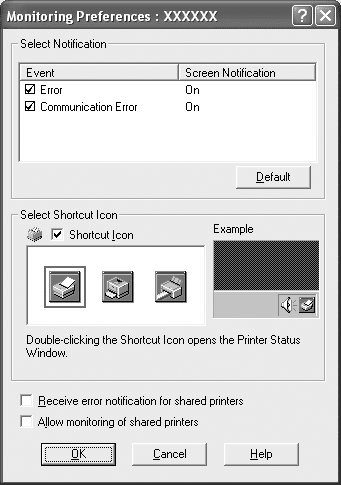
Click the Monitoring Preferences button. The Monitoring Preferences dialog box appears.
|
 |
The following settings are available:
|
Robot | Wechat Video Downloader
Grandparents want to save grandchildren’s voice messages with video. Expatriates want to preserve hometown festival clips before the group chat is deleted. Friends of a deceased user want a last laugh captured in a private video.
Most likely, however, the robot will simply evolve. It will move from network interception to AI-based video reconstruction. Imagine a future robot that watches a video once, trains a generative model on the user’s viewing patterns, and then recreates the video from memory—pixel by pixel, sound by sound—without ever downloading it. That would be a robot in the truest sense: not a thief of data, but a prosthetic for human recall. The WeChat Video Downloader Robot is, at its heart, a commentary on platform power. When a company decides that your videos are “licensed, not owned,” and that they may vanish at any time, users will naturally seek tools to resist. The robot is crude, legally dubious, and technically fragile—but it is also ingenious, democratic, and deeply human.
explicitly forbid “using any robot, spider, or other automatic device to access the service for any purpose.” Violation can result in permanent account bans. Tencent has also successfully sued developers of downloader bots in Chinese courts under anti-circumvention provisions of the Cybersecurity Law.
The very desire for a downloader robot will pressure regulators. The European Union’s Digital Services Act and China’s own Personal Information Protection Law both emphasize data portability. A future lawsuit could compel WeChat to provide a native “Export My Videos” button. The robot would then become obsolete—not because it lost, but because it won. wechat video downloader robot
adds another layer. Downloading a video you have permission to view does not grant permission to reproduce it. If a friend shares a copyrighted movie clip in a group chat, downloading it is technically infringement, regardless of the tool used. Conversely, downloading your own video (which you uploaded to Moments) is legally unambiguous but still prohibited by WeChat’s terms.
Whether that assertion is heroic or futile depends on your tolerance for the gray zone. But one thing is certain: as long as WeChat exists and videos matter to people, someone, somewhere, will be building a better robot.
In environments where content can be retroactively censored or removed (by platform or by state actors), downloading a video becomes an act of defiance. Whistleblowers, human rights monitors, and citizen journalists rely on downloader robots to create immutable copies. Most likely, however, the robot will simply evolve
More sophisticated robots thus resort to . These are “robotic process automation” (RPA) bots that simulate a human: they open WeChat, play the video full-screen, record the display region frame by frame, and encode the result. While lossy and slow (real-time capture requires 1× playback speed), this method bypasses all network-layer encryption. Some advanced variants use GPU-accelerated encoding and can process multiple videos in parallel using virtual Android emulators.
Unlike YouTube or TikTok, which offer (sometimes grudging) built-in download buttons, WeChat treats most of its video content as ephemeral. Videos shared in “Moments” (the platform’s version of a timeline) or in group chats are often subject to automatic deletion, quality compression, or link expiration. It is within this frustrating gap between user desire and platform limitation that the concept of the emerges—not as a single device, but as a conceptual and technical solution designed to reclaim agency over digital content.
Introduction: The Fleeting Nature of the Walled Garden In the vast ecosystem of global social media, WeChat occupies a unique and paradoxical position. It is simultaneously a private messaging app, a professional collaboration tool, a news aggregator, a payment platform, and a mini-app browser. With over 1.3 billion monthly active users, it is the de facto operating system for daily life in China and a growing presence in international diaspora communities. Yet, for all its sophistication, WeChat remains a notoriously difficult environment for one seemingly simple task: downloading videos . That would be a robot in the truest
It reminds us that software is not fate. Behind every endpoint, every encrypted packet, every expiring URL is a person who wants to keep what they have made or been given. The robot does not merely download videos; it asserts that in the tension between ephemerality and permanence, the user should have the final word.
Users leaving WeChat for another platform want to take their media history with them. Since WeChat has no official data export tool (unlike WhatsApp or Telegram), a robot is the only exit strategy. Part IV: The Gray Morality—Legal and Ethical Dimensions It would be naive to present the WeChat Video Downloader Robot as a purely benevolent tool. It operates in a legal and ethical twilight.
Note:|
Click the Default button to revert all items to the default settings.
|

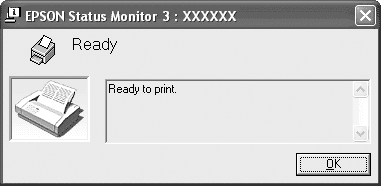
Accessing EPSON Status Monitor 3
 Note:
Note:|
It might not be possible to retrieve the printer status during printing. In this situation, click the EPSON Status Monitor 3 button in the Utility tab, and use the printer with the status window left open.
|
Installing EPSON Status Monitor 3
|
Make sure that the printer is off and that Windows is running on your computer.
|
|
Insert the printer software CD-ROM in the CD-ROM drive.
|
Note:|
If the language selection window appears, select your language.
If the EPSON Installation Program screen does not appear automatically, double-click the My Computer icon, right-click the CD-ROM icon, click Open in the menu that appears, then double-click Epsetup.exe.
|
|
Click Continue. When the software license agreement screen appears, read the statement, then click Agree.
|
 |
Click Custom Install.
|
 |
Click the EPSON Status Monitor 3 button.
|
 |
In the dialog box that appears, make sure that your printer icon is selected, and click OK. Then follow the on-screen instructions.
|
 |
When the installation is complete, click OK.
|